
Prometheus
Prometheus
The story of Prometheus begins with a barren earth, a new and unshaped frontier stretching vast and empty before him. While this may seem intimidating to some, Prometheus saw only a blank canvas.
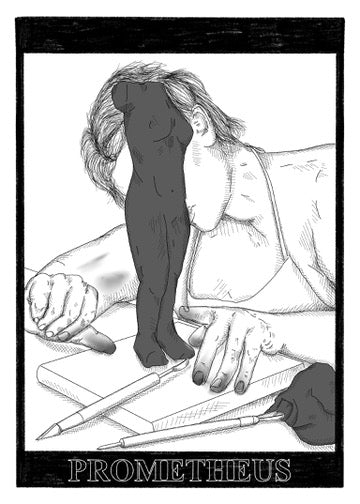
The god of forethought knelt to the ground. Slowly, but with clear intent, he scooped up a handful of earthen clay and began to work. With tender and thoughtful hands, he carefully shaped each figure. His kind heart bled into his creations, imbuing each lovingly with the breath of life. Prometheus gifted them all with intelligence, potential, and most importantly, curiosity. These figures, his humans, would be his finest creation.
Like any new creation, humanity’s beginnings were fraught with challenges. The forefront of these hurdles came from none other than Zeus himself, the ever-capricious king of the gods. Zeus ruled that these new beings, the humans, would make sacrifices to the gods, and began to ponder what that sacrifice should be. To this end, Prometheus proposed a test – he would provide two offerings, and Zeus would choose his favorite.
Prometheus, always with his beloved humanity in mind, prepared his offerings. The first, a pile of bones wrapped beautifully in glistening fat, stunning, yet devoid of any true sustenance. The second was just the opposite – a hearty portion of beef concealed within the ugly, modest ox stomach. Knowing Zeus and his proclivity to superficiality, Prometheus presented the two dishes.
Just as he planned, Zeus chose the bones with no hesitation. Now, humanity would be able to keep their full portions of food to eat, burning for the gods only scraps. As the first offerings came in from the mortal world, Zeus realized his mistake. He had been outwitted, humiliated. This could not stand unpunished.
In his wrath, Zeus revoked the gift of fire. Without it, they could not burn the offerings that insulted him so. The mortals were plunged back into darkness and cold. Prometheus, seeing his precious creations struggle to even survive, let alone thrive, knew he had to act. Zeus refused to return the flame to humanity, and Prometheus foresaw that they would die without it. And so, he chose a path that would enshrine him in history forever – Prometheus stole the eternal flame.
He knew the risks. They didn’t matter. His own survival meant nothing if he could save his humans, and his bravery was not unnoticed. Prometheus returned the flame to his mortals, and almost instantly they began to thrive. Metalworking, cooking, warmth, light – these would not have been possible without Prometheus.
The progress of humanity had not gone unnoticed on Mount Olympus. Zeus was not blind to the fire below. He knew it could only have been Prometheus who betrayed him, and Prometheus would not deny it. He knew that without his help, humanity would not have survived their cradle. Whatever punishment Zeus could dream, it would be worth the suffering.
Oh, and what a punishment Zeus dreamt. Prometheus found himself bound in the Caucasus mountains, straddling Europe and Asia. Each day, a flock of eagles – the emblem of Zeus himself – would descend upon Prometheus. Talons and beaks tore at his flesh, ripping and slashing until his liver was consumed. At sundown, the eagles fled, allowing Prometheus’s immortal body to regenerate. The next morning, just as his wounds finally closed, the eagles would return, starting the cycle anew. This eternal torment was Zeus’s grim and unyielding revenge, a punishment fit for a god.
Despite his unending suffering, Prometheus bore his punishment with a stoic endurance. His spirit remained unbroken, sustained by his love for humanity, and the knowledge that he had acted for a noble cause. His tale is one of sacrifice, but also of dedication, a symbol of what it truly takes to act for the greater good.