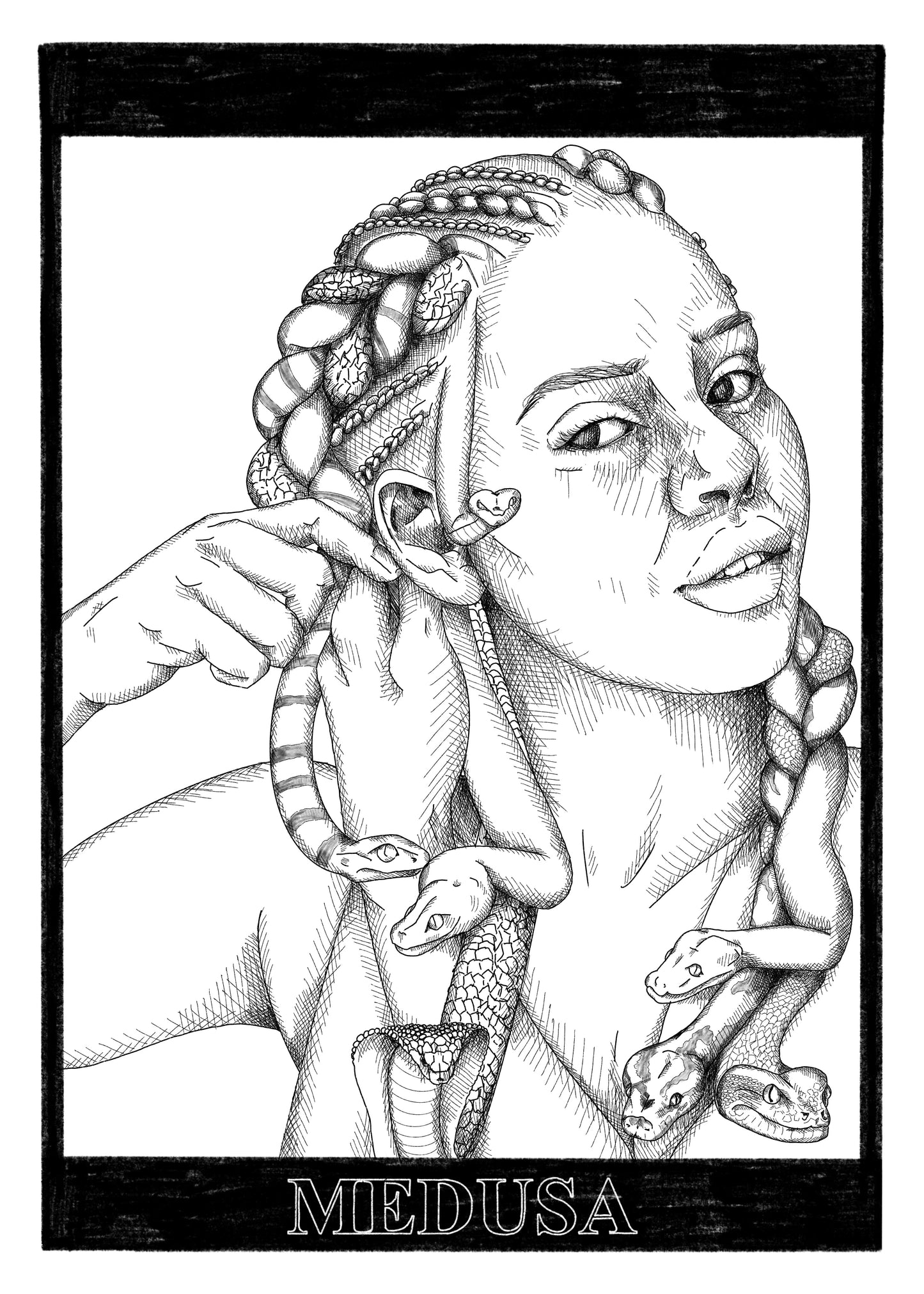

Medusa
Medusa
This story begins, as many do, with a beautiful maiden. Medusa stunned those around her with her glow, and men threw themselves at her feet. Medusa could not be tempted, though – her vow to Athena was more important to her than any man could ever be.
Medusa drew the gaze of all who beheld her – mortal and god. As she bathed in the waters of the Mediterranean, the mighty god Posiedon became entranced by her beauty. His desire was all consuming, and he would stop at nothing to have the girl who would not be taken by any man.
Medusa dried herself in the sun, believing she was alone on the shoreline. Her body glistened with the salt of the sea, and Poseidon could no longer contain his lust. He approached her on the beach, begging to touch her. Frightened, Medusa grabbed for her tunic and began to back away, but Poseidon would not relent. For each of her steps back, he took one forward, always closing the space between them just a little bit too tight. Medusa repeatedly declined his offer, but to no avail.
Eventually, she was forced to turn her back and run. Poseidon, undiscouraged, chased her in hot pursuit. Medusa ran up the hill back towards town, and found herself on the steps of the temple she tended so lovingly. In hopes of finding sanctuary within the walls of Athena’s temple, she ran inside. Before she was able to close the door, though, Poseidon was inside the temple too.
With nowhere left to run, Medusa was out of options. Poseidon claimed the girl in an act of violence that echoed through the heavens, desecrating the sacred grounds. This infuriated Athena, yet her wrath fell not upon the transgressor but on his victim.
At the hands of Athena’s wrath, the beautiful Medusa was transformed. Her hair morphed into a writhing nest of snakes, and her once-kind eyes became a harbinger of death, turning to stone any who dared to meet her gaze.
Some say this curse was a twisted form of protection, Athena’s way of shielding Medusa against further indiscretion. Whatever mercy she may have intended, though, Athena had confined Medusa to a life of solitude and despair. Her only companions remained the stone forms of those who sought to capture her beauty for themselves.
Into this tapestry of tragedy stepped Perseus, a hero born of Zeus's lightning and mortal bravery. Tasked with the impossible, Perseus set forth to claim the head of Medusa, armed with gifts from the gods and a heart that knew neither fear nor failure. Guided by the reflective shield bestowed upon him by Athena, Perseus navigated the Gorgon's lair, where time itself seemed petrified in the stony gaze of Medusa's victims.
In the silence that danced with shadows, Perseus confronted Medusa, not as a monster, but as a victim of the gods' capricious whims. With a swift stroke guided by fate and fortune, Perseus severed Medusa's cursed head, ending her torment but beginning a new chapter of her existence as a symbol of deadly power.
Perseus wielded Medusa's head as both shield and sword, turning foes to stone and altering the course of battles with the mere unveiling of her gaze. Yet, even in death, Medusa's story was one of sorrow and exploitation, her legacy reduced to a tool in the hands of those who could never understand her pain.
As time turned the pages of history, the tale of Medusa evolved, weaving through the ages as a tapestry rich with themes of beauty, betrayal, and the quest for redemption. In the end, Medusa's story is not just a myth from a bygone era but a reflection of timeless struggles, reminding us that even in the darkest tales, there can be found a glimmer of understanding, a call for compassion in the face of unfathomable