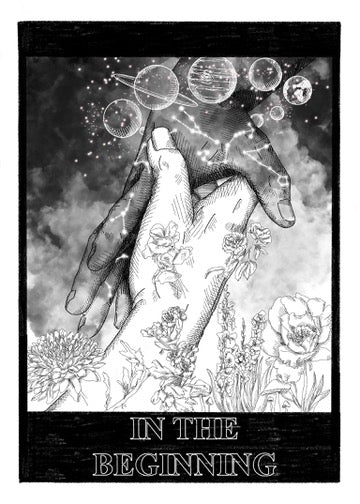

In The Beginning
In The Beginning
There was nothing. Only a boundless, raging ocean void known as Chaos. Dark, swirling waters with no edges and no bottom, just endless, infinite nothing.
The attributes of this pool became so vivid, so intense, that they themselves personified, and thus emerged the children of Chaos, Nyx and Erebus. Night and the Depths. While they seemed as though they would never be able to create anything other than the chaos from which they came, they had one other thing in common- peace. There was something quiet and calm, the eye of the storm that was Chaos, where Nyx and Erebus came together to create Love.
Love, regarded as the source of all things. The beginning of emotion and passion and faith. The beginnings of beauty and value and treasure, all spring from one, which is Love. From Love came pieces of Nyx and Erebus that they didn’t even know they had. Light and Day began their reign, and the noise of Chaos was washed away, leaving only the brightness of life.
Then, from Light and Day, came Gaia and Ouranos. Mother Earth and Father Sky. And Mother and Father they were, to three sets of children. First came the Hecitonchires, The Hundred-Handed Ones. Known to have fifty faces, one for each emotion, and a hundred hands and feet, they were naturally skilled warriors. Adaptable and quick-minded, they were often considered too smart for their own good. Next, the Cyclops. The behemoth race of one-eyed carnivores, many of whom would go on to great fame in their futures.
Despite their great strengths, or maybe because of them, Ouranos feared his monstrous children. He locked them away in the pits of Tartarus, hoping they would simply wither. Instead, they sat patiently, waiting for an opportunity to strike.
The third and final group of Ouranos and Gaia’s children came to be known as the Titans. The ones who rise against. The Titans were some of the most powerful creatures to exist since Chaos, and one among them far exceeded the rest. Kronos, Titan of Time. Kronos began to feel his father was no longer fit to rule, and so began the plot to overthrow him. Kronos used a scythe, a long curved blade, to slice his father Ouranos into pieces, ensuring he would never heal. Ouranos was scattered across the world, and as his severed phallus hit the sea, Aphrodite was born, the first of the Twelve Great Olympians.
From the insurrection forward, Kronos and his queen, Rhea, lead the Titanomachy. This was a time of perfect order, when all things knew their place. The reign of perfection can never last forever, though, and Kronos knew he would one day be dethroned.
The five children of Rhea and Kronos were the first he suspected to upset this world of perfect order. Hades, God of the Underworld, Poseidon, God of the Seas, Hera, Goddess of Community, Hestia, Goddess of the Hearth, and Demeter, Goddess of Grains.
Kronos, having betrayed and overthrown his own father, saw his fate flash before his eyes at the birth of his oldest child, and so he did what he thought was the only way to protect himself - he consumed the baby whole. This same path was followed for the next four children, each being swallowed by their father on the day of their birth. Rhea, however, wished a better life for her children, and sought to protect their sixth and final child, a boy named Zeus. On the day Zeus was born, Rhea wrapped a rock in his baby blanket, and Kronos, not wanting to waste a second, swallowed the rock in one gulp, thinking it was Zeus.
Rhea sent Zeus to be raised far from the domain Kronos ruled, to be nurtured and raised by her own mother, Gaia. Zeus spent his early years devising a plan to dethrone and defeat his father, and to rescue his brothers and sisters, who had remained immortal and unharmed in the stomach of Kronos.
Unlike when Kronos had overthrown his father Ouranos, Zeus would not be able to face his father alone. Kronos had power beyond any that Zeus had known. And so, Zeus turned to the pits of Tartarus for help. He recruited the assistance of the Hecitonchires and the Cyclops, who had been stewing in their anger towards Ouranos and their siblings, the Titans, for millennia.
Together, they hatched a plan. Zeus stole the legendary scythe Kronos had once used to betray his own father, and as the squadron flanked Kronos, Zeus took his first strike. He ripped open his father’s stomach, and the other gods burst forth, now fully grown and ready to defeat their father.
Thus began the Titanomachy, a war that raged for what seemed like centuries. The Titans rallied together and fought against the gods, and though there were but few Titans, those that remained were mighty. The tides began to turn in favor of the Titans, and the gods began to fear they would lose. At their lowest point, though, a Titan named Prometheus arrived at their battleworn doorstep.
At first, they shunned him, thinking him to be an ally of the enemy, but Prometheus was anything but. He felt the Titans had ruled unjustly, and brought the gods information that he hoped would help them to overthrow the Titans. No one knows what was disclosed to the gods that night, but the next morning the gods made their final play against Kronos, and as the scythe once wielded by Kronos against Ouranos fell into the hands of Zeus, Prometheus knew he had secured a victory for the gods.
Zeus slashed and ripped at the flesh of Kronos, and eventually, he was damaged beyond repair. Despite these devastating blows, he remained alive, his immortality a gift left over from his ancestor, Chaos. A gift? A curse? It was no longer clear.
With Kronos imprisoned eternally in the pits of Tartarus, the gods began a new reign. All that followed thereafter, on Olympus, on Earth, or in the Underworld, occurred under the watchful eye of the Twelve Great Olympians.