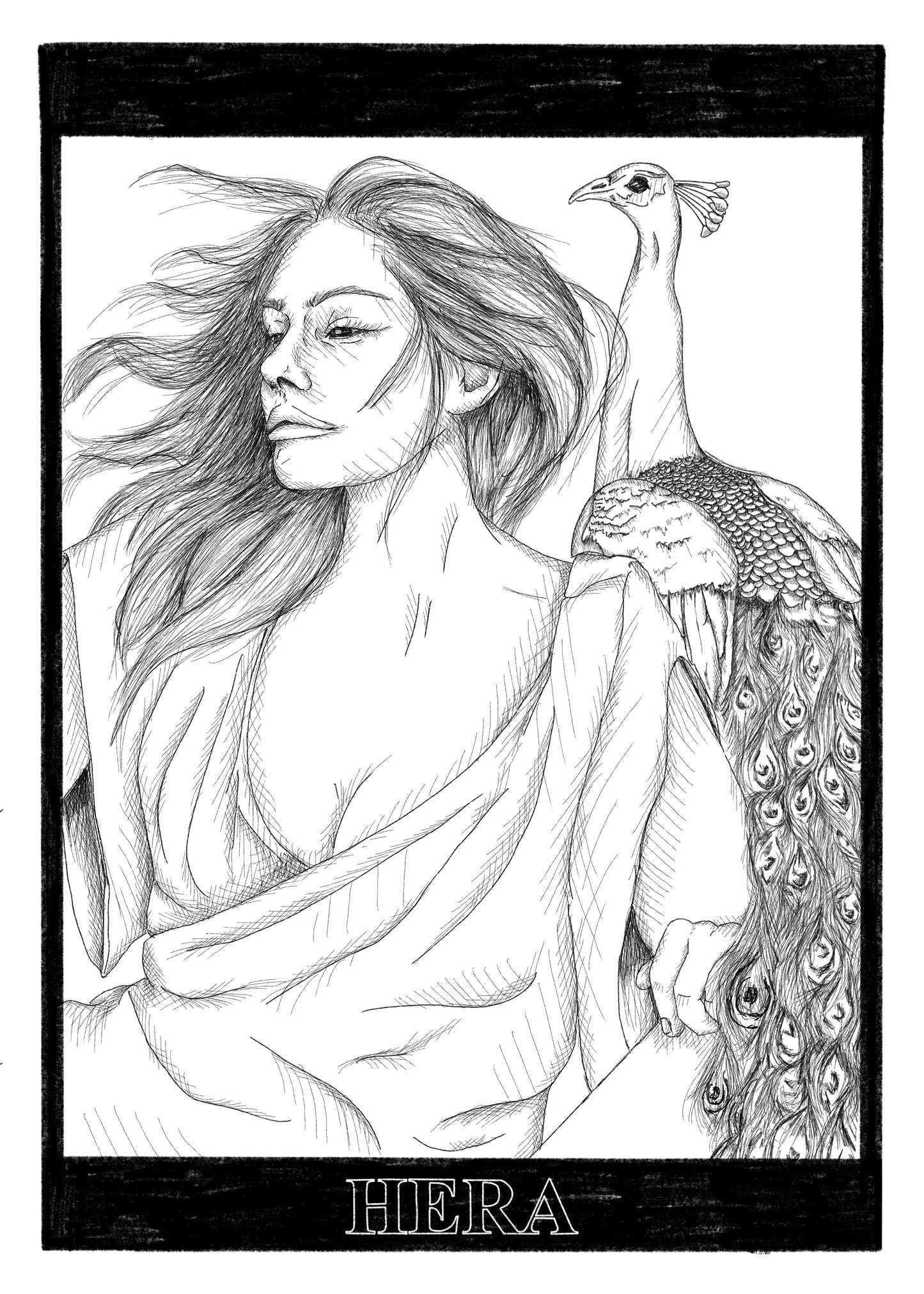

Hera
Hera
Severe, both in beauty and in nature. Hera’s authority as Queen of the Gods was both revered and feared, her austere exterior a thin veil barely masking the tempest of wrath that lay within her.
Fueled by rage and jealousy, Hera was a force to be reckoned with. Her marriage to Zeus was marred by countless infidelities. Because she could not act so defiantly against her husband, her vindictive revenge was often focused on those with whom he betrayed her.
Hera’s vengeance was swift and exact, a complex symphony of punishments reflecting each act of betrayal. The most notable victim of Hera’s divine retribution may be Heracles, the demigod result of one of Zeus’s many mortal affairs. Heracles was beloved by his father, fated to be one of the great heroes of Greek myth.
Though Heracles was himself just an innocent child, Hera saw him as an embodiment of Zeus’s sins. Hera used him as a pawn in her cruel games of revenge against her husband. She devised for Heracles the infamous Twelve Labors, a series of grueling tasks designed to break his strength and spirit. These trials were meant to be an assertion of Hera’s powers, to demonstrate the consequences of crossing her. She wished to prove to Zeus that though she could not take action against him directly, those he cherished would suffer at her hands.
In every act of vengeance and every calculated punishment, Hera’s nature was laid bare—a goddess whose beauty and authority were matched only by her capacity for vindictive retribution. Her story was one of divine power, a reminder of the high price that could be paid for betrayal and defiance in the world of gods and mortals alike.