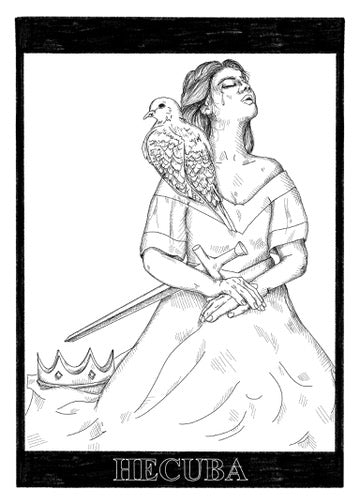

Hecuba
Hecuba
The tragedy of Troy does not end with their fall. In the ashes of her once-beautiful city, Hecuba found herself a queen without a throne. She bore the weight of her city’s defeat, heavier even than the chains that now bound her, taken captive as a slave.
Hecuba lost not only her throne, her city, and her title to the relentless Greek siege, but much of her family too. At the start of the war, Hecuba found herself desperate to protect her youngest son, Polydorus. She sent him to Thrace, entrusting his safety to King Polymestor, an old ally.
Now, at the end of the war, Hecuba saw a glimmer of hope in her new life as a slave. She was being sent to Thrace, where she hoped to reunite with her last living son. When she arrived, though, Polydorus was nowhere to be found.
Allegiances shift in the wake of conquest, and Thrace was no exception. Polydorus appeared to his mother in a haunting dream, revealing the truth of his grim fate. King Polymestor, swayed by greed and the promise of political gain, had murdered the boy in cold blood.
As Hecuba began to grapple with this news, she was shaken awake to yet another blow – her last surviving daughter, Polyxena, was sacrificed at the tomb of Achilles. Her death mirrored the tragic fate of Iphegenia at the war’s outset. Polyxena had bravely accepted her fate, choosing the honor of a sacrificial death over the shame of slavery. Her bravery only deepened the despair that wracked her mother.
Now a mother with no children, Hecuba’s sorrow turned to vengeful fury. She devised a plan to exact retribution on Polymestor, who still believed she was unaware of his treachery. Hecuba used her demure nature to lull Polymestor into a false sense of security, just as she had felt when she believed her son to be alive and in his care.
“Such a shame, what happened to Troy. A beautiful city,” Polymestor sighed, no trace of guilt in his voice. Truly, a man without sympathy.
“It was.” Hecuba’s voice was level, but she turned her face away as her cheeks flushed with rage. This was her opportunity to set the plan in motion – she could not reveal herself now. “It could be again, one day.”
At this, Polymestor’s ears perked up. “What do you mean? The city was sacked. The riches are gone…. Aren’t they?”
“Not all. We hid – no, I’ve said too much already.” Hecuba cut herself off.
“You can trust me,” Polymestor said, with no hint of irony. Despite the lump in her throat and the suddenly renewed urge to slap the king across the face, Hecuba pushed on.
“Not here. Meet me in the slave’s quarters tonight, away from listening ears. Bring your sons,” she said. “If you wish to help me retrieve the riches, it will take you all to do it.”
With that, she hurried away, trusting that Polymestor’s greed would deliver him to her doorstep that night. Of course, it did. The men arrived at the slave quarters, and Hecuba waved them inside. They listened eagerly by the dim light of the oil lamps as Hecuba spoke of great riches buried under the ruins of Troy.
As her tale came to a close, she spoke, “and I will regain what is mine.” Right on cue, the other slave women began their attack. The women surged into the room, overwhelming the men with ease. Polymestor’s sons were ruthlessly slaughtered right in front of him. As his grief overtook his body, so too did the slave women, knocking him to his knees and restraining him by the arms.
Hecuba approached, a dagger in each hand.
“I know what you did to my son.”
With that, she plunged the daggers deep into his eyes, blinding him.
“May you live in the darkness, stumbling without a guide. You have left me without light in my life, now I have done the same to you.”
Hecuba had avenged her children, but the relief it brought was fleeting. Consumed by her losses, the queen’s spirit could withstand no more. She wailed so long and so loud that she was transformed, taking the shape of a mourning dove. Her cries would echo across the oceans forever, the somber sound of a mother wronged.