
Argus
Argus
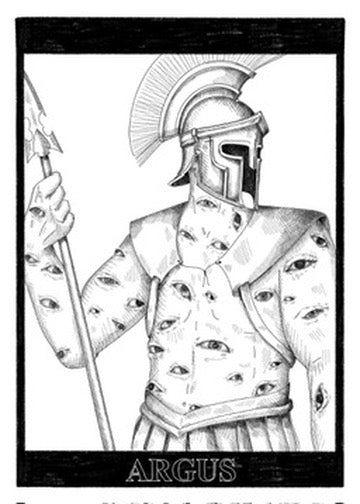
Argus Panoptes, a guardian of unparalleled fidelity. His broad shouldered stance made him difficult to pass, but his true asset was his eyes. Hundreds of them covered his body, vigilant and striking. Only a few would ever close for rest at a time, allowing him to remain ever-informed. Such was his acuity that Hera, Queen of the Gods herself, appointed him her personal watchman.
Hera’s faith in Argus was not misplaced. His accomplishments spoke for themselves, and his loyalty to his mistress Hera never faltered. This is how he came to have his most notable charge, the guardianship of Io. Io was once a nymph of incomparable beauty, now transformed into a white heifer. Io’s curse was Hera’s doing, an act of divine intervention. Hera, filled with a jealousy that burned hotter than the sun, was known to take action against the consorts of her husband Zeus. Io’s story was no different.
Despite her new look, Zeus still found himself infatuated with Io. Knowing her husband’s relentless nature, Hera turned to her most trusted watchman, asking for his help. Argus obliged willingly, leading Io to the sacred groves of Nemea. There, he chained her lead to an olive tree, where he stood vigilant watch over the cow with an unwavering gaze.
Days passed. Argus never so much as blinked all his eyes at once, each taking turns to ensure no trespassers would sneak by. Soon, though, Zeus would dispatch a trusted servant of his own: the ever-cunning Hermes. Known for his wit and guile, Zeus entrusted Hermes with the near-impossible task of passing by Argus to free Io. Though Hermes knew the difficulty of the job at hand, he accepted, and began his scheme.
A head-on confrontation would never work. Argus was too strong, and too quick. Instead, Hermes engaged Argus in a battle of endurance. Adorned in his winged sandals, Hermes began to talk. He told stories, played melodies on his lyre, spoke and sang in his lilting tone. He used every trick he knew to lull the powerful Argus into a deep slumber. It was a battle as much of wits as of will.
Finally, after what seemed an eternity, Hermes’s labors began to bear fruit. Argus fought to keep awake, his head clouding with thoughts of a soft place to rest. For the first time in his life, Argus’s hundred eyes all closed at once, and the watchful stare was broken. Argus slumped into a deep sleep, and Hermes seized his opportunity. He struck swiftly, and took the life of the all seeing guard. Io was free.
Hera was heartbroken over the fate of her loyal servant. Her heart filled with a deep sorrow, but also with pride. Argus had remained devoted to his mistress until the very end, fighting Hermes and his wiley tricks until his body gave out. For this, Hera sought to immortalize Argus in the heavens. She took his hundred eyes, symbols of his unwavering vigilance, and set them into the tail feathers of the peacock, her favorite bird.
Thus, Argus continued to watch over the world, even in death. His legacy endures in the iridescent splendor of the peacock, a reminder of loyalty and duty even in the face of an unbeatable adversary.