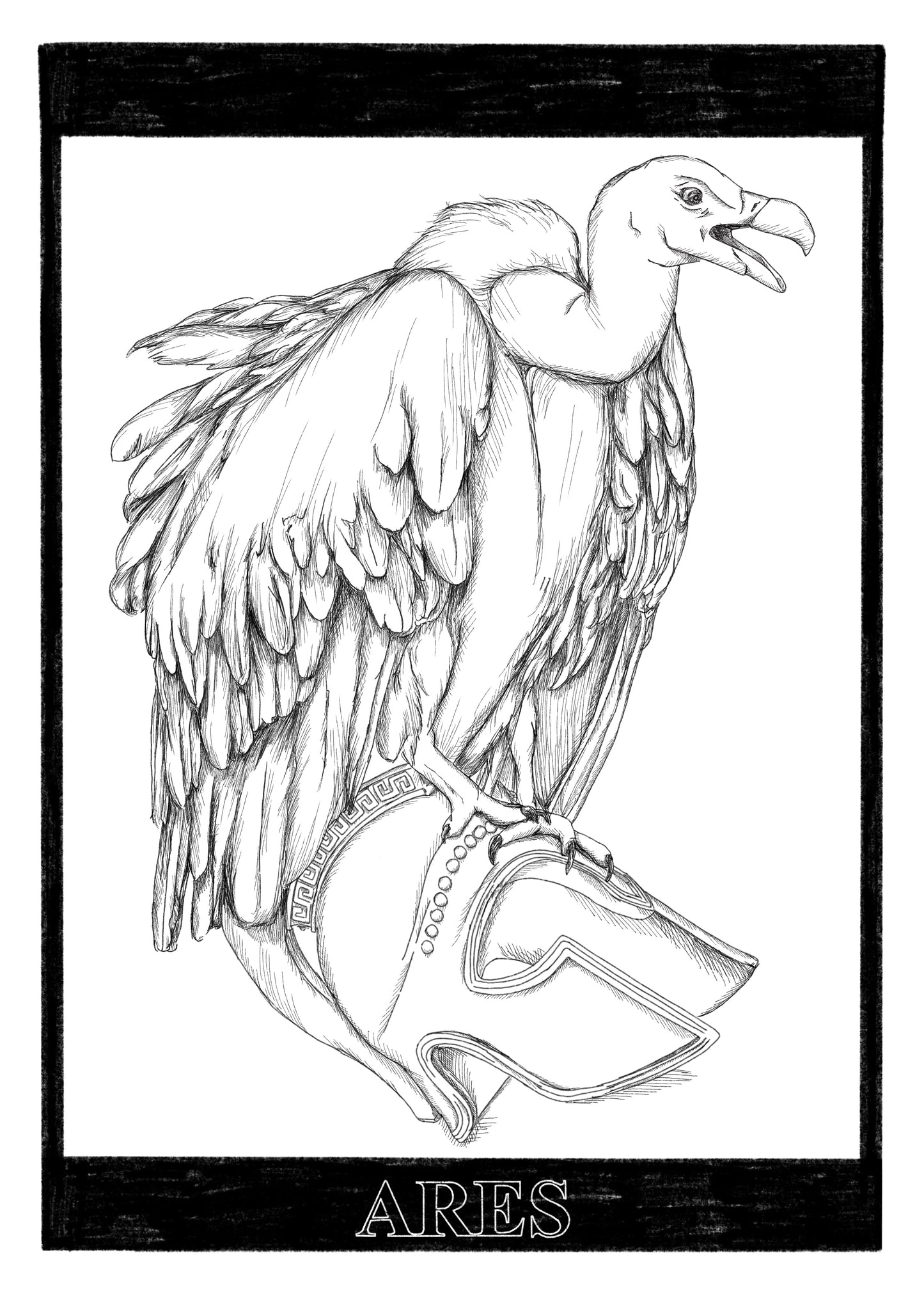

Ares
Ares
Ares thrived on the battlefield, a realm where violence and chaos reigned supreme. He found himself a perfect reflection of the throws of war and the destruction it wrought. Even his name, ἀρά, means “ruin.” His presence induced a primal dread in mortals and gods alike, the fear of losing control.
Ares was a force of unrestrained fury. His very presence on a battlefield was a harbinger of the carnage to come, his actions marred by an impulsive rage that knew no bounds. Unlike Athena, Ares was no patron of calculated precision. Instead, he plunged headlong into the fray, driven by an insatiable thirst for bloodshed.
What Ares thought was bravery often proved itself to instead be the rash actions of an unprepared man. This flaw, his hamartia, is what so often brought the god to his knees. It is said that the giant twins, Otus and Ephialtes, once sought to challenge the gods. They were themselves creatures of immense strength, and their braggadocio did not go unnoticed. They taunted Ares, rightfully assuming he would be the easiest god to tempt into a fight.
When the god heard the twins, he could not contain his rage. His thunderous footsteps pounded against the earth as he approached their home, the element of surprise long gone. Otus and Ephialtes were ready for Ares’ arrival, and the brazen god strode confidently right into their trap.
Ares was captured in an urn crafted to hold even the most powerful of deities. No matter how hard he pounded against the ceramic walls, they simply would not shatter. His anger boiled within him for months, but to no end. His formidable rage was rendered useless against this prison.
The twins, audacious as they were, did not keep silent about their victory. They ranted and raved about their angry little prisoner, laughing as they watched the urn rattle and shake from within. Soon, their taunts and leers once again caught the attention of the gods. Athena and Hermes, together forming a foolproof plan, stepped in to free the god of war.
This story became a cautionary tale, told time and time again through the centuries. Ares served as a reminder of the detriments of rash action, and a warning that even the mightiest can fall.
His symbols—a vulture, a wild boar, and the implements of war—spoke of his dominion over carnage and mayhem.
The jar, a vessel of dark enchantment and unyielding strength, was a prison fit for a god of war. The giants, with their cruel sense of triumph, kept Ares contained within, relishing the irony of trapping the god of battle in such a confined space. Ares, known for his boundless rage and fierce independence, found himself restrained, his formidable strength rendered useless against the confines of his prison.
For months, Ares was trapped in the jar, a symbol of how even the greatest forces could be humbled. The world outside continued in its turmoil, unaware of the god of war’s plight. His confinement was not only a physical restraint but a blow to his very essence, a reminder of the fragility of even the most imposing powers.
Eventually, it was through the intervention of the gods and the cunning of his allies that Ares was freed from his imprisonment. The giants’ ambition and cruelty were met with the wrath of the gods, and the jar was shattered, releasing Ares back into the world. His escape was marked by a return to his unrelenting fury, a renewed embodiment of the chaos and strife that he so embodied.
Ares’ entrapment in the jar became a cautionary tale among the gods, a reminder that even the mightiest can be subdued, if only for a time. His legacy remained one of raw, unrestrained aggression, a testament to the primal forces that shape the world. And so, he continued to move among mortals and gods, a living embodiment of the ruinous power that lay just beneath the surface of civilization.