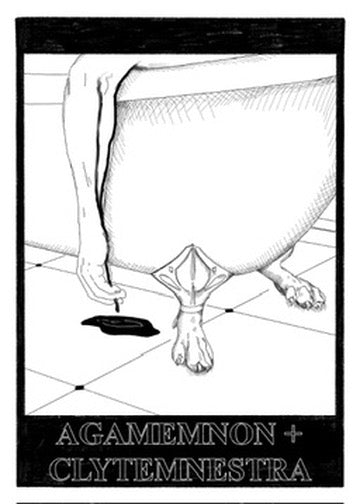

Agamemnon + Clytemnestra
Agamemnon + Clytemnestra
A sacrifice must be meaningful. That is what makes it a sacrifice, after all – giving up something loved to gain something needed. Agamemnon knew this, and when it came time to launch the Greek fleet, he was prepared to sacrifice whatever necessary.
For weeks, the wind would not blow. Without it, the fleet couldn’t travel, and the Trojan war wouldn’t be fought. As commander of the Grecian troops, Agamemnon couldn’t allow that — He would get his men across the sea, no matter the cost. He began to seek advice wherever he could find it. He prayed to the gods, he walked the roads, and he spoke to everyone in town. His long journey seeking answers left him sweaty, frustrated, and exhausted. Eventually, though, his path led him to the Oracle Calchas.
Agamemnon pounded on the door of the old seer, not caring about the time of night. The longer he waited, the more frustrated he got, banging on the door to wake the old man from his slumber. Finally, Calchas shuffled to the entryway, rubbing the sleep from his eyes.
“Are you Calchas?” Agamemnon asked gruffly.
“Yes.” The old man stated simply, and the two stared at each other for a moment. Agamemnon had expected him to continue, but finally spoke.
“I am –”
The oracle cut him off. “I know what it is you seek.”
Frustrated with the games Calchas seemed to be playing, Agamemnon pounded his fist against the doorframe. “If you know why I’m here, then speak. Share your prophecy with me. Tell me how to stir the winds.”
“The winds can only be brought by the sacrifice of a golden daughter. The eldest, your beautiful Iphegenaia.”
Agamemnon’s rage turned to panic as he choked on his words. “My – my daughter?”
“Yes. She must die by your hand, in sacrifice to Artemis. When her blood is spilled, the winds will return and carry your fleet safely to Troy.”
With that, Calchas blew out his candle and returned to bed, leaving Agamemnon standing in the dark.
The next morning, the breeze still refused to return. By the following night, Agamemnon knew what he had to do – Calchas had not been unclear in his instructions. And so, he called for his daughter.
Iphegenaia was brought to her father by a messenger, not knowing her own fate. Agamemnon did not hesitate, and swung an ax with precision and force, enough to take the girl’s life in a single stroke. Though he had no regrets about his actions, he did not wish suffering upon her.
As the oracle had promised, with the spilling of her blood returned the wind. Anxious both to launch his fleet and to flee from the scene of his crime, Agamemnon and his men leapt into action. The entire militia was at sea within the hour.
Just as the final ship pulled away, the men heard a blood-curdling scream echo across the ocean – Clytemnestra had discovered their deed. Her oldest daughter sacrificed to send men to war, only to beget more death. As she knelt in the blood of Iphigenia, she swore that Agamemnon would not be forgiven for this. Clytemnestra would avenge her daughter.
The years passed. As the Trojan war waged overseas, Clytemnestra was left charged with the task of ruling over Mycenae. As queen, she ruled well in her husband’s absence, becoming an honored and revered leader. As such, upon his return over a decade later, Clytemnestra was not inclined to give up her post.
Though she was not apt to return the crown, she relented easily, biding her time. Her plan was already in action, she just had to play the role she had written for herself – the dedicated wife, keeping the house running while her husband was at war. Agamemnon never sensed an issue, simply happy to be home. Clytemnestra cooked and cleaned, letting Agamemnon settle back into his life, all the while with a storm of rage brewing just beneath her skin.
They went on like this for days, Agamemnon oblivious to his wife’s anger. Finally, though, Clytemnestra found her moment. Agamemnon, frustrated from a day of untangling webs that he had not woven, retreated to his bedroom. Clytemnstra offered him a cup of tea and drew him a bath, which he gladly accepted. She reached for the kettle she had already prepared, and poured him a mug.
“This smells familiar, what is it?” He asked.
“Oh, I’m not sure. It’s just a blend of leaves from a gentleman in town, a booth at the square,” Clytemnestra answered confidently. With no reason to doubt her, Agamemnon took a sip, and began to relax.
As he settled into the hot bath, he felt his muscles relaxing just a bit more than he had expected. As he slipped out of consciousness, he finally recognized the scent coming from the steam of his tea – hemlock.
Clytemnestra lay in wait, listening for the clatter of the teacup against the marble floor. As the cup shattered, she knew Agamemnon had fallen victim to her ploy, sinking slowly into the water. She entered the bathroom, not willing to let him go in peace. She intended to kill him the same way he had taken her daughter from her – swift, but brutal.
“...why…?” slurred Agamemnon, barely able to keep his head above the water.
“That girl was my life, and you took her from me. Balance is all we have, Agamemnon.”
And so, with the single, powerful swing of the same heavy ax, Clytemnestra took her husband's life. As she watched his blood dye the bathwater red, she felt herself breathe for what felt like the first time in a decade – Iphegenaia was avenged.