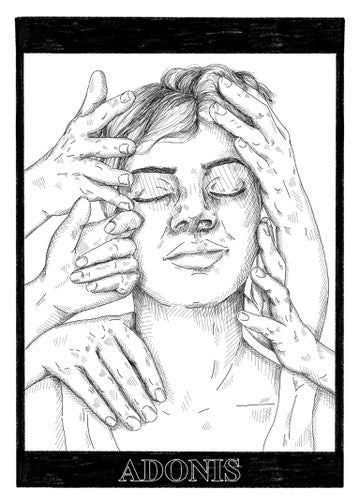

Adonis
Adonis
Some say it is better to have loved and lost than never to have loved at all. The pain and loneliness that comes from a love lost would not be felt without the joy it brought before, and Adonis was the most joyous of all.
The most beautiful mortal for miles and miles, Adonis found himself at the heart of a celestial conflict. Aphrodite and Persephone, stunning beings in their own right, found themselves head over heels for this one mortal man. The two goddesses fought so ruthlessly that eventually, a royal decree was enacted by Zeus, just to stop the yelling. The king of the gods declared that Adonis would spend four months with Persephone in the Underworld, four months with Aphrodite on Olympus, and the remaining four months wherever he so chose.
Adonis, favoring the warmth of the sun over the shadows of the underworld, elected to remain with Aphrodite during these four extra months. Even then, his heart was not solely hers – Adonis was admired by many. His stories of love transcend the confines of gender, connecting him with gods, heroes, and mortals alike.
Though Adonis lived a life of love, the fabric of his tale was woven with threads of tragedy. His many consorts often fought, and he became a pawn in their disputes. The final play was a wild boar, sent to attack Adonis while out hunting. This was no accident, but a clear act of divine retribution, the perpetrator of which remains shrouded in mystery. Was it Ares, driven mad by jealousy? Aphrodite was his lover, after all. Could it have been Apollo, seeking vengeance against Aphrodite for the blinding of his son Erymanthus? Or Artemis, retaliating for the death of her devout follower Hippolytus at Aphrodite’s hands?
Anyone could have sent the boar. This is the tragic fate of a man who wove a tale of passion, wrought with jealousy, as passion often is. Adonis’s tale is one of the transient beauty of life.
As Adonis bled out, cradled in the arms of a grieving Aphrodite, the Earth itself began to mourn. The loss of such beauty seemed unfair, and so it was replaced. Where his spilled blood splashed against the dirt, Anemone flowers began to bloom. From Aphrodite’s tears grew roses. These became the symbols of true love we know today, born of tragedy and the ephemeral nature of a love beyond belief.
Festivals were held in honor of Adonis, his memory and the grief it brought echoing across Greece. Rituals mirrored the depths of Aphrodite’s despair, with women tearing their tunics and unleashing wails of mourning. They also engaged in the symbolic killing of plants, representing the cycle of life, death, and rebirth that Adonis himself traversed.
Though Adonis suffered a life cut short, his story remains timeless. He serves as an ode to the complexities of love and the inevitably of loss, a reflection of the way the two are often intertwined. To lose a love is worse than death, but without it, there is never life.